



Picture someone in their twenties scrolling through profiles on a Tuesday night, weighing a percentage match more carefully than the nervous energy from an actual conversation already underway. That swap, gut feeling traded for a number generated by code, says something about how an entire generation now approaches romance.
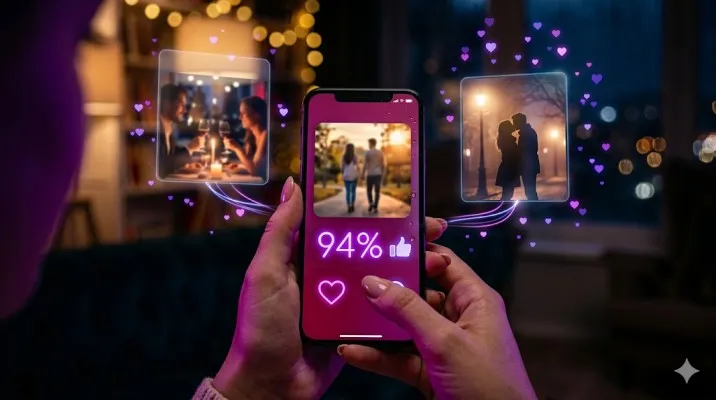
The Match Percentage Replaced the Gut Feeling
Dating used to run on instinct. A glance across a room, a nervous laugh, or a friend’s hunch that two people belonged together did the heavy lifting for centuries. Gen Z grew up with a different starting point, an app doing the introductions before either person says a word. Parimatch runs on that same broader logic that swallowed dating long ago. A screen weighs odds and probabilities that a person used to work out by feel, whether the subject is a football match or a first date. Neither version asks anyone to trust a gut feeling anymore. That handoff did not happen overnight, and it did not stop with romance.
A Generation Raised on Recommendation Engines
Spotify picked the songs. Netflix picked the shows. By the time dating apps entered the picture, recommendation logic already felt like a normal way to make choices rather than a strange substitute for judgment. Among partnered adults under thirty, roughly one in five say they actually met their current partner through an app, proof the system works often enough to keep everyone logged in.
A handful of patterns keep showing up in how Gen Z daters behave once an app is involved.
- About three in ten US adults have tried a dating app at some point, a share that has barely moved in years even as the apps themselves keep changing.
- Daters draft bios, polish them, and sometimes lean on an app to generate part of the text, which blurs the question of who actually wrote the message.
- Friends compare compatibility scores the way classmates once compared report cards, treating a percentage as a small piece of social proof.
None of that means the generation stopped thinking for itself. It just moved the thinking earlier in the process, into the settings menu instead of the second date.
Why the Numbers Feel More Honest Than a First Date
A first date can lie. Bad lighting flatters no one, nerves make people awkward, and a single bad joke can sink a good match before either person learns anything real. Numbers do not flinch the same way.
Sports fans run into a similar problem from another angle. The way analysts use data to forecast a result strips out the noise a nervous spectator cannot see from the stands, and plenty of Gen Z daters want that same noise cancelled out of romance. Hard to argue with that logic, at least on paper.
Whether the comparison holds for two human beings the way it holds for a back four is another question entirely.
Where the Trust Runs Out
The faith in algorithms has limits, and the limits show up fast. Americans are split almost down the middle on whether dating apps are even safe to use, forty nine percent say no, forty eight percent say yes, a slight dip from a few years back when safety ratings ran a little higher. Close to half of everyone who has used an app, forty eight percent, reports running into at least one unwanted behavior along the way, unwanted contact, harassment, messages nobody asked for.
A few things keep the trust from going all the way.
- Verification gaps still let fake or outdated profiles slip through, even on apps that market themselves as safe spaces.
- Companies tune algorithms to keep people swiping, not necessarily to get them off the app and into a real relationship, an incentive most rarely advertise.
- Fifty nine percent of Americans, asked plainly, say dating apps have had neither a clearly positive nor a clearly negative effect on relationships overall, a shrug dressed up as a statistic.
Ask anyone who matched with a photo three years and one haircut out of date how much they trusted the algorithm after that.
Gen Z did not replace judgment with code so much as outsource the first round of it, keeping the final call for themselves once an actual conversation starts. Sort of works. Mostly.